Guide
How to build self-belief with a weekly contract
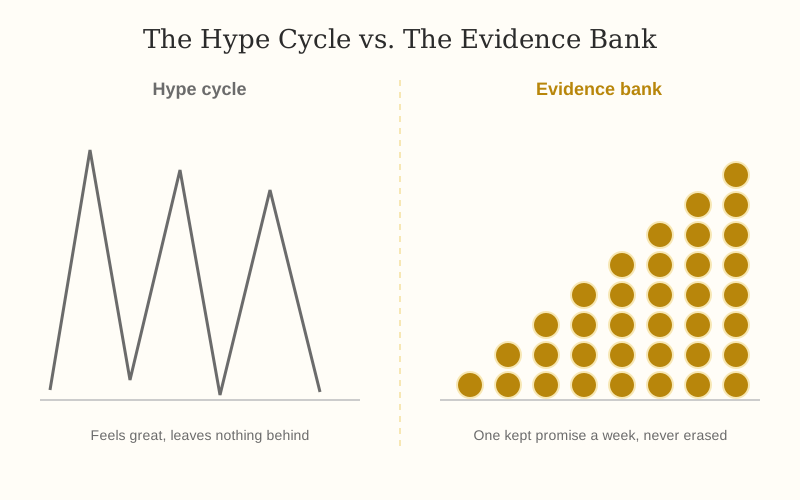
Self-belief isn't something you talk yourself into. It's a balance you build up — one small promise at a time — and like any balance, what matters is the deposits, not how you feel about them on a given day.
Why affirmations rarely move the needle
Telling yourself you're capable while holding a private record of abandoned commitments creates a contradiction, and the record usually wins. Belief follows evidence. If the evidence says you don't finish things, no amount of repetition will overwrite it.
The way out isn't more conviction — it's new evidence, produced deliberately and at a size you can guarantee.
The weekly contract method
- Write one promise for the week. Specific enough that at the end of the week the answer is a clean yes or no.
- Shrink it until it's almost certain. Ten minutes, one page, one phone call. You're building a record, not testing your limits.
- Name the day and the trigger. "Tuesday after dinner" beats "sometime this week" every time.
- Record the outcome the moment it happens. Unrecorded wins evaporate; recorded ones become the evidence.
- Write next week's contract straight away. The gap between weeks is where most people drift off.
What to do in the week you miss
You will miss one. The week you miss is the week the whole thing is decided, because self-punishment reliably predicts quitting and a clean restart reliably predicts continuing.
- Don't cancel the record. One miss doesn't erase what came before it.
- Halve the promise rather than repeating the same one.
- Remove the specific obstacle that stopped you, not a general one.
- Restart the next day, not the next month.
This is why The Community Bank of Self-Belief includes a Belief Bailout: a missed week costs no coins and carries no penalty. The system is built so a bad week can't put you into deficit.
Tracking belief so you can see it grow
The point of tracking isn't discipline, it's memory. Your mind keeps failures for free and discards successes within days, so any honest picture of your progress has to live outside your head.
In the app, every member opens with ten Invisible Gold Coins — a starting balance of belief nobody has to earn. Each kept weekly contract adds one coin, with a celebration and a permanent entry in your coin history. Over a few months that history becomes something you can actually read back on a low day, which is when self-belief is worth the most.
The approach comes from the book The Community Bank of Self-Belief by Tony Egar. If you'd like the surrounding ideas, read building confidence through small wins, how to celebrate small wins and working with an accountability partner. For ideas you can start today, browse these 25 small wins examples.
Frequently asked questions
- What is self-belief?
- Self-belief is your working expectation that you'll follow through on what you decide to do. It's built from an accumulated record of kept promises, which is why it responds to action far more than to reassurance.
- How do you build self-belief when you've failed a lot?
- Start with promises so small that failure is nearly impossible, and record every one you keep. A long history of broken commitments isn't reversed by a big effort — it's reversed by a new, unbroken run of tiny ones.
- Is self-belief the same as confidence?
- They overlap. Confidence usually refers to a specific situation; self-belief is the broader sense that you're someone who follows through. Both are built the same way: evidence first, feeling second.
- How long does it take to build self-belief?
- Most people feel a shift after three to six kept weekly promises. It builds slowly and then holds, because it's based on a record rather than a mood.
Your first ten coins are free
Write your first weekly contract and start the record today.
Open your account